


 Back
Back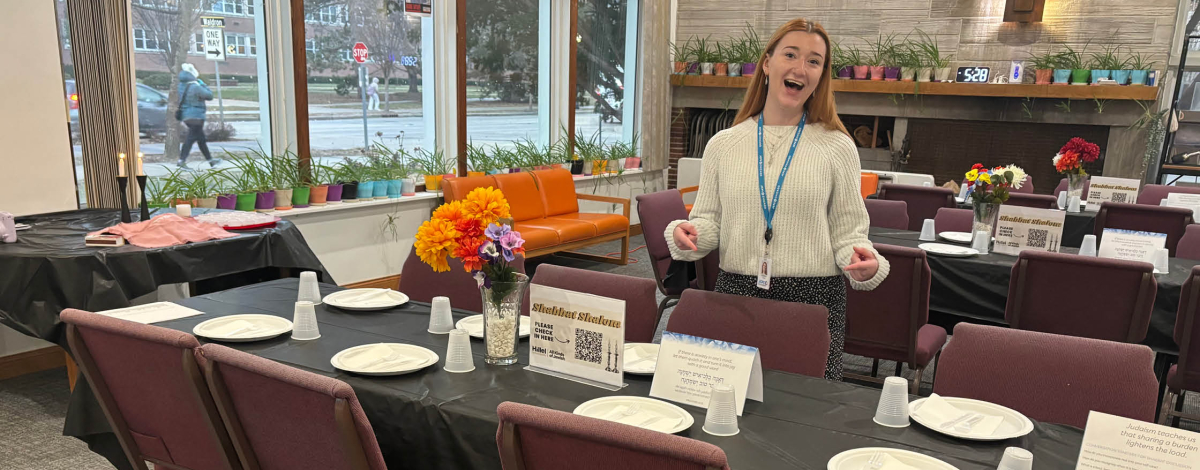
Expanding Mental Health Shabbat Beyond the Synagogue
When Jewish Community Services intern Ally Frank helped to update JCFS Chicago’s online Mental Health Shabbat resources, she never imagined it would lead her back to her alma mater. But just a few weeks later, Ally led a Mental Health Shabbat service at the Purdue Hillel in West Lafayette, Indiana.
Mental Health Shabbat—an initiative of JCFS in partnership with No Shame On You and the Chicago Board of Rabbis—has always aimed to help synagogues create space for meaningful conversations about mental health through a Jewish lens. But this year, Ally and Abuse Prevention Coordinator and Mental Health Educator Bracha Jakofsky determined that Mental Health Shabbat resources should be expanded to include individuals and families who want to bring them to their Shabbos tables.
In preparation, Ally and Bracha updated the Mental Health Shabbat Resource Guide and added ways to make the resource more accessible.
“We were able to add a printable table tent that we suggested people put on Shabbos tables,” Ally said. “It has a piece of Torah scripture, mental health conversation starters, and mental health resources as a way to bring the idea of Mental Health Shabbat to anyone’s table at any time.”
Ally, who is a recent graduate of Purdue University and past vice president of Hillel on the West Lafayette campus, thought about how a Mental Health Shabbat service could be applied there. When she contacted the Hillel’s executive director to propose the service, he invited her back to lead it.
Ally set the Shabbos table, including the new table tents.
“It was really well received,” she said. “The students were intrigued by what the Torah says about mental health. I think there are misconceptions that religious Judaism or the Torah doesn’t prioritize mental health the way that it prioritizes other things in our lives. Through my work, I want to show that taking care of one’s mental health is actually one of the greatest mitzvahs that can be done.”
Along with the D’var Torah, Ally shared a bit about her own mental health struggles while she was college. Afterward, students approached her and said the service really resonated with them because they have not prioritized their own mental health amid the demands of college culture.
“Creating spaces where people can talk about mental health, whether it's at home, at college, in a synagogue, or anywhere in the community, helps decrease stigma and increase access to support,” said Bracha, who said she was elated when Ally proposed a Mental Health Shabbat service at the Purdue Hillel. “Ally understood the importance of reaching individuals where they are, which is what Mental Health Shabbat is all about.”
Go to Mental Health Shabbat | JCFS to learn more.